Finance Crosscheck Daily / October 27, 2026
HSBC’s profit jump is not all recurring growth
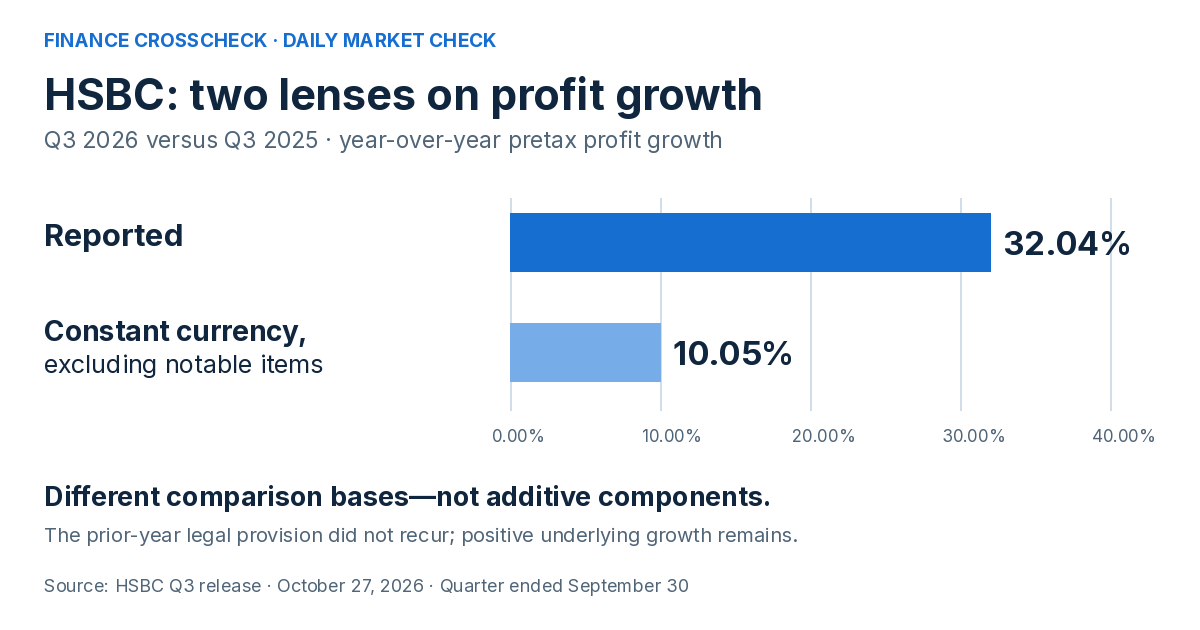
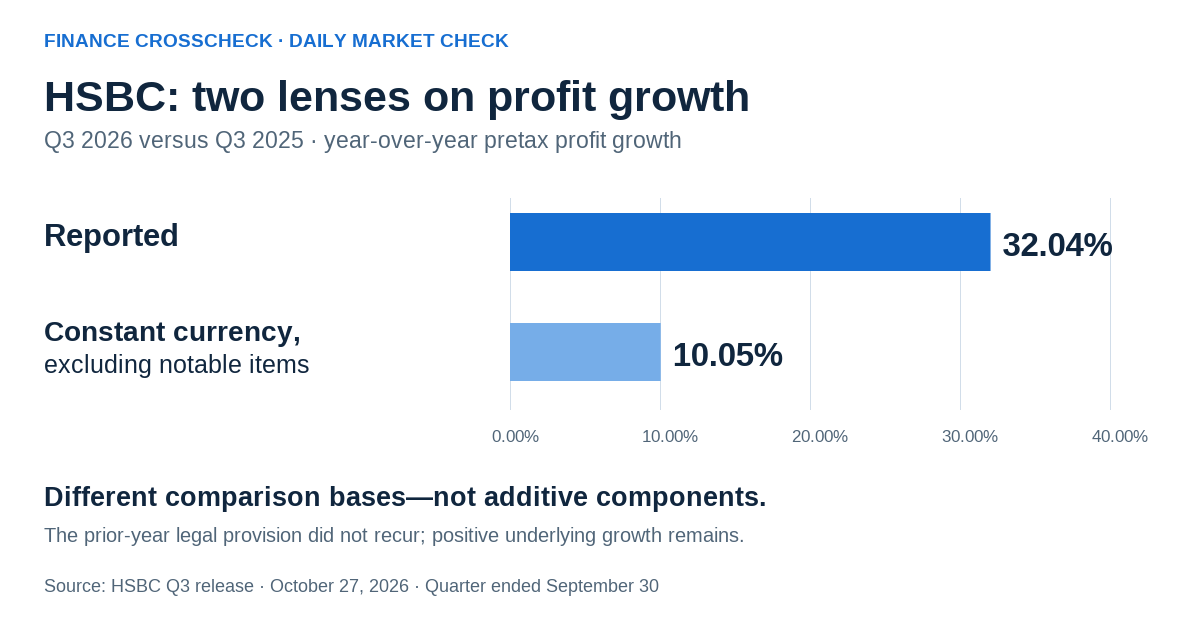
HSBC’s reported pretax profit rose 32.04%, but growth was 10.05% at constant currency excluding notable items. The second measure removes currency effects and HSBC-designated notable items; it is not a guaranteed recurring growth rate.
Tuesday briefing · About 4 minutes to read. Source cutoff: October 27, 2026, 06:00 UK time.
Confirm your email to join. Target delivery: 7 AM UK time (Europe/London). Signup uses Kit; privacy note.
Two lenses on HSBC’s profit growth
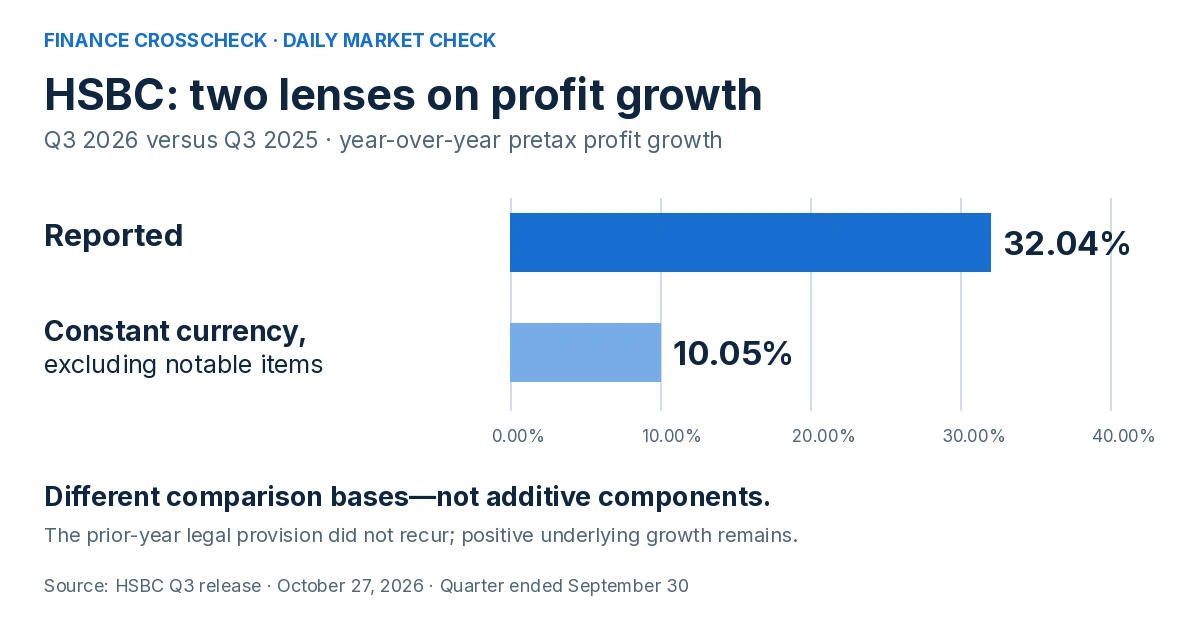
Reported pretax profit growth
+32.04%US$9,632.00 million versus US$7,295.00 million.
Constant currency, excluding notable items
+10.05%US$10,021.00 million versus US$9,106.00 million.
HSBC Q3 release — October 27, 2026 · Exact chart CSV · PNG · SVG
Separate the rebound from the recurring engine
What changed
Reported pretax profit increased from US$7,295.00 million to US$9,632.00 million. On HSBC’s constant-currency basis excluding notable items, it rose from US$9,106.00 million to US$10,021.00 million. These are different measures, not additive components.
Why the comparison matters
The prior-year US$1,421.00 million legal provision did not recur. Its effect is already within the expense comparison; adding it again would double-count the benefit. Constant currency removes exchange-rate translation effects; excluding notable items follows HSBC’s own classification.
Our interpretation
Our reading: underlying expansion remains positive, but the 32.04% headline should not be treated as a recurring growth rate. The more useful question is whether revenue momentum can sustain returns while funding distributions and rebuilding capital headroom.
The counterargument
This is not simply a weak result disguised by adjustments: constant-currency profit excluding notable items still grew 10.05%. However, reported profit fell 5.07% from Q2. CET1—core equity capital relative to risk-weighted assets—was 13.90%, down from 14.10% in June and below management’s 14.00%–14.50% medium-term target, not evidence of a regulatory-minimum breach.
What to watch
Watch the capital trajectory, credit costs and the execution of HSBC’s intended buyback of up to US$1.00 billion. An announced intention is not a completed repurchase. Treasury yields are dated context, not a prediction of the next policy decision.
Two developments to keep in view
Capital is the counterweight to HSBC’s earnings growth
The CET1 capital ratio was 13.90% at September 30, down from 14.10% in June. Management’s medium-term target is 14.00%–14.50%. This is a comparison with that target, not a claim that HSBC breached its regulatory minimum. A buyback of up to US$1.00 billion is intended, not completed.
HSBC’s original releaseThe ten-year Treasury par yield held at 5.00%
The October 26 observation was unchanged from October 23. This is the U.S. Treasury’s indicative bid-side par-curve estimate, not a live traded quote or an equity-market mood score. It supplies dated rate context without forecasting the next policy decision.
U.S. Treasury daily par yield curveAI investment: distinguish funding from returns
Meta’s funding plan illustrates why announcements are not cash received. Its October 26 filing describes approximately US$35.00 billion of preliminary offerings, including common shares linked to expected forward agreements and mandatory convertible preferred shares. Meta expects no initial forward proceeds; the filing says its separate approximately US$60.00 billion planned at-the-market share-sale program has no agreement. SpaceX’s approximately US$40.00 billion contemplated GPU finance lease remains conditional and outside our fixed company panel. Our October 26 investment-cycle assessment remains Watch, with Limited confidence. Financing plans are not realized sales or proof of returns; reported platform profit and cash generation remain counterevidence.
Current valuations and speculative trading remain unassessed; this is not a numerical bubble index.
Previous edition and deeper research
October 26: GE’s quarterly and nine-month cash · Sixteen historical energy-company studies
These retain their original observation dates. Unchanged research is not a new event.
Evidence, dates and limitations
Scope and interpretation
HSBC is today’s company-specific focus, not a claim about all banks or the market. Ten previously checked company reports remain dated background. No current market-wide valuation or sentiment score is published. Treasury October 26 observations are indicative par-curve estimates, not live traded quotes. Facts and our interpretation are separated. This is educational research, not personalized investment advice.
HSBC original release · Treasury original data · Methodology and disclosures
What arrives in your inbox
A clear opening finding, useful numbers, an original chart and a concise interpretation with the strongest counterargument. Follow the source links when you want to go deeper.
Read the published October 27 edition →
The website, original chart and matching daily email use the same accepted source snapshot.
Know someone who checks the numbers?
Share the public edition, without subscriber-specific email links.
financecrosscheck.com/newsletter/2026-10-27/Financial figures use two decimal places for display; trailing zeros do not imply greater source precision. Calculations retain unrounded inputs, so displayed components may not add exactly. Dates, counts and source documents keep their original form.